Loading image...
Agadir’s Grand Stadium: Dh15.4 Million to Revamp Its Surroundings
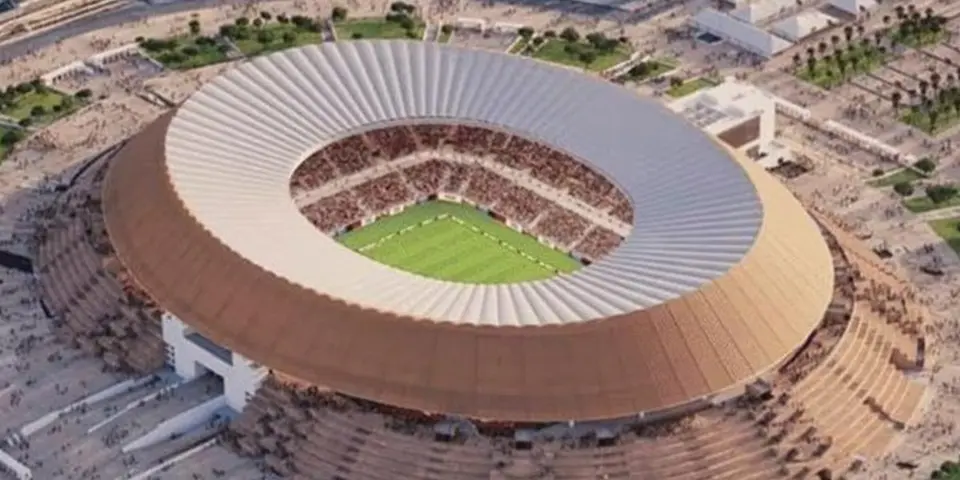
With a view to the 2030 World Cup, Agadir is investing 15.4 billion dirhams to develop an urban park and parking facilities around Adrar Stadium. The project complements the modernization of the sports complex, whose total budget reaches 3.5 billion dirhams. Goal: to transform the site into an urban hub that meets international standards.
Agadir’s Adrar Stadium will undergo a complete overhaul for the 2030 World Cup, with a total investment of 3.5 billion dirhams allocated to the various contracts launched by the National Agency for Public Equipment (ANEP). In this framework, the local development company (SDL) Agadir Souss-Massa Aménagement has issued the tender for the development of the large urban park and parking facilities surrounding the stadium. This programme commands a provisional budget envelope of MAD 15.45 million. It should be noted that this new investment builds on the other actions launched over the past three years.
Several lots have already been awarded, including the development of parking areas around the stadium, planting and irrigation works, the layout of the urban park and the road network, as well as ongoing works on the Olympic pool and the large hall. For reference, ANEP recently launched three additional lots to upgrade the stadium, representing a total investment of MAD 2.419 billion. These new calls for proposals target the most structural components of the project, notably the roofing and facades, technical fluid installations, electrical systems, and other complementary services.
Five months for the works
The execution schedule for the entire project sets a five‑month deadline. This time constraint underscores the urgency of the operation, whose goal is to turn the Grand Adrar Stadium and its surroundings into a new urban hub for the benefit of citizens. The site plan also includes pedestrian pathways to provide comfortable circulation for spectators. The sanitation component is equally important, with the installation of circular pipelines as well as the construction of inspection chambers and manholes. These underground infrastructures are designed to ensure effective storm‑water management, thereby preventing flooding on the newly created roadways and parking areas.
30,000 trees already planted
Regarding landscaping and public lighting, these elements form the essential aesthetic and safety dimension of the large urban park integrated into the project. Accordingly, no fewer than 600 trees and palm trees are slated for planting. The operation includes relocating and reinforcing irrigation networks to ensure the survival of the vegetation in its new environment. This approach preserves the natural heritage while structuring the park’s green spaces.
In total, more than 30,000 trees have already been planted on at least 430 hectares surrounding the stadium. The irrigation of these green areas is supplied by three treated‑water reservoirs with capacities of 9,000 m³, 5,400 m³ and 4,500 m³ respectively. The stadium’s inner enclosure occupies 32 hectares, while 50 hectares are dedicated to roads, pathways and pedestrian zones. Finally, for lighting, the site will be equipped with 33 cylindrical‑conical lamp posts fitted with 132 LED floodlights.
Source: leseco