Loading image...
Nabil Hamina Concludes University Expansion Tour in Tiznit: Two New Faculties Strengthen Ibn Zohr University’s Academic Network
The Faculty of Economics and Management and the Faculty of Legal and Political Sciences in Tiznit welcomed their first cohort on September 30, 2026.
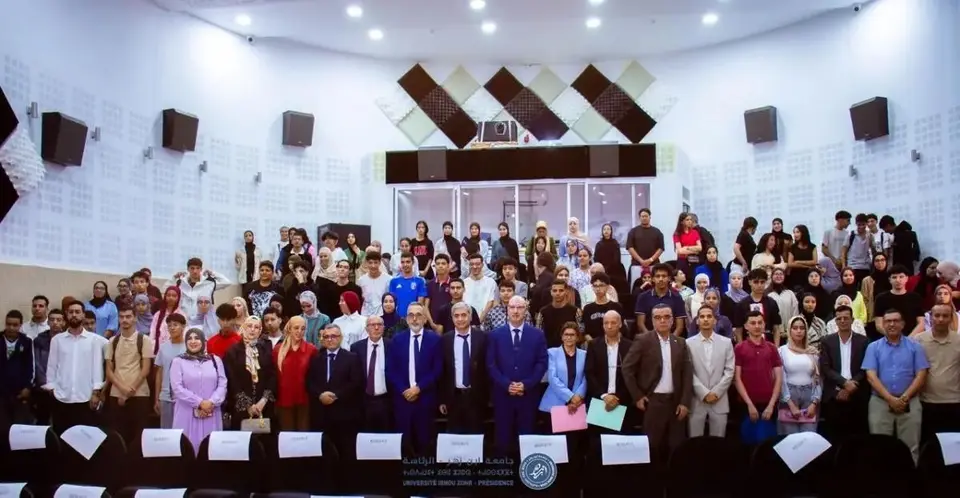
Ibn Zohr University concluded, on Wednesday, September 30, 2026, in the city of Tiznit, its tour to launch its new university establishments for the 2026–2027 academic year. The academic launch was held at the Faculty of Economics and Management and the Faculty of Legal and Political Sciences, marking a new phase in the university’s presence in the province and reaffirming its drive to expand its academic network and bring higher education closer to students.
The ceremony was chaired by Nabil Hamina, president of Ibn Zohr University, alongside Abderrahmane Jouhari, governor of Tiznit Province; Abdellah Ghazi, president of the Tiznit municipal council; and Mohamed Cheikh Bella, president of the provincial council. Several elected officials, local authorities, heads of decentralized government services, institutional and academic stakeholders, university partners, as well as the university’s vice-presidents, teacher-researchers, administrative staff and students from the first cohort of the two new establishments were also in attendance.
The opening of the two faculties represents a qualitative transformation of Tiznit’s university landscape, given the specialized programs they offer in economics and management, and legal and political sciences. It will enable students from the province and neighboring regions to pursue their university studies closer to home, while strengthening equal opportunities and territorial equity in access to higher education.
In his address, Nabil Hamina stressed that the creation of the two establishments forms part of Ibn Zohr University’s strategy to expand and diversify its academic offerings, bring its institutions closer to students and their families, and strengthen the university’s engagement with its economic, social and cultural environment.
The university president explained that the two faculties represent a further building block in establishing an integrated university presence in Tiznit Province. He indicated that the range of programs would be gradually expanded through the creation of new courses and specializations responding to students’ needs and changes in the economic and social environment, while helping attract students from the province and neighboring regions.
Nabil Hamina praised the joint efforts of the various partners to ensure the project’s success, commending the support provided by the local authorities, elected councils, partner services and institutions, as well as the efforts made by Ibn Zohr University’s staff to create the right conditions for the start of classes and to welcome the first cohort of students.
Pending completion of the university facilities designated for them, the two establishments are being temporarily housed in spaces at the Raïs Haj Belaïd Music Conservatory. The arrangement brings culture and art together under one roof with science and university education, in keeping with the cultural and historical character of the city of Tiznit.
The city’s university experience is not starting from scratch: Ibn Zohr University has been present in Tiznit since 2019 through its supervision of the Studies and Training Center, which has hosted several university programs. The university is now moving to a more advanced stage with the creation of two autonomous and specialized university establishments.
For his part, Abdellah Ghazi, president of the Tiznit municipal council, said the development strengthened the city’s position as a hub of science and knowledge. He stressed that the university project could help build an open knowledge system in which the university and scientific research intersect with the economy, culture, the arts, digital technology and civil society, thereby enhancing local skills and potential.
Mohamed Cheikh Bella, president of the Tiznit provincial council, described the opening of the two faculties as an exceptional moment in the province’s history. He said it crowned years of advocacy, work and partnerships that had made the university project a reality, while stressing the need to continue efforts to complete its various components and attract additional university establishments and specializations.
With the Tiznit stage, Ibn Zohr University has concluded a broad tour to launch several of its new university establishments for the 2026–2027 academic year. The drive has extended to several provinces and cities within its territorial jurisdiction, reflecting an ambition to reshape the university landscape and expand the range of programs and specializations.
This momentum confirms a new direction for Ibn Zohr University, based on deploying university education across wider territories, reducing distances for students and aligning institutional expansion with development needs. It is opening broader prospects for younger generations in education, specialization, scientific research and innovation.