Loading image...
Fish Farming on Agricultural Farms: Chtouka Aït Baha at the Heart of a New Economic Experiment
At the Souss-Massa Region’s Economic Back-to-School event, held in Agadir on November 12, 2026, a pilot project to integrate fish farming into six agricultural holdings in Chtouka Aït Baha was presented.
The Souss-Massa region is moving toward a more diversified and sustainable agricultural model by integrating fish farming into agricultural activities. This approach seeks to leverage the potential available within farms, create new sources of production and income, strengthen food security, and open up promising economic opportunities for investors and farmers, particularly in the face of growing challenges linked to water scarcity and climate change.
Against this backdrop, the city of Agadir hosted a strategic debate on Thursday, November 12, 2026, on the future of aquaculture integrated into agricultural activity, during the latest edition of the Souss-Massa Economic Back-to-School event. The event was organized at the initiative of the Regional Council and CGEM Souss-Massa, in partnership with Atlas Original, under a theme highlighting the potential of this activity to profoundly transform the national production system.
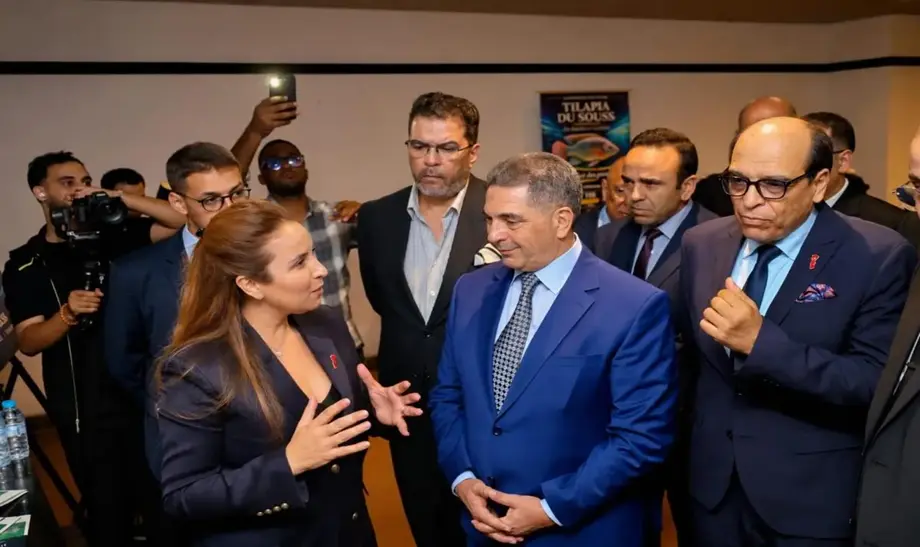
The economic gathering was attended by Souss-Massa Wali Saïd Amzazi, Governor of Chtouka Aït Baha Province Mohamed Salem Sebti, and Regional Council President Karim Achengli, alongside representatives of institutions and the private sector, as well as more than 300 economic operators, investors and entrepreneurs. Their presence reflected growing interest in production alternatives capable of supporting the transformation of the agricultural sector.
The initiative is particularly important for the Souss-Massa region, which has built up extensive experience in agricultural production and exports and established itself as one of the country’s leading hubs for early-season produce and citrus fruits. However, mounting pressure on water resources is making it necessary to rethink certain production methods and seek innovative solutions that reconcile economic profitability with environmental sustainability requirements.
In this context, Wali Saïd Amzazi called for the establishment of a clear institutional framework to oversee the initiative and ensure its success, stressing the need for technical approaches that respect the environmental specificities of the targeted areas. He also underlined the importance of making use of existing water infrastructure on farms, particularly irrigation-water collection and drainage ponds, which could be mobilized to develop fish farming in accordance with rules ensuring the preservation of natural balances.
For his part, Souss-Massa Regional Council President Karim Achengli announced that the Council was ready to provide the necessary support to investors and stakeholders wishing to engage in this initiative. He said the project represented an opportunity to broaden the regional economic base and move toward new productive activities capable of responding to economic and environmental changes, while creating additional opportunities for wealth and job creation.
For his part, CGEM Souss-Massa President Mr. Driss Bouti said that diversifying the economic fabric had become a necessity imposed by current challenges, with businesses now expected to contribute to developing innovative production solutions that go beyond traditional models. He added that aquaculture was a promising field that could draw on the region’s accumulated agricultural expertise and establish a new complementarity between crop production and fish farming.
Among the key outcomes of the meeting was the presentation of a pilot project aimed at integrating fish farming into six agricultural holdings. The initiative was launched by CGEM Souss-Massa in cooperation with several investors and farmers, with the contribution of the National Agency for Water and Forests and the support of the wilaya authorities and the Regional Council.
Chtouka Aït Baha Province was selected to host the first phase of the initiative, given its agricultural assets and production potential. The project is expected to serve as a practical laboratory for testing the feasibility and development potential of this model before considering its expansion to other areas of the region.
The initiative’s objectives go beyond adding a new activity to agricultural holdings. It aims to establish a supplementary source of food production by supplying fish, an important source of protein, at affordable prices for all segments of society. The project also seeks to enable farmers to make better use of their infrastructure and equipment, diversify their income and reduce their dependence on a single source of production.
Supporting the initiative, Chtouka Aït Baha Province Governor Mohamed Salem Sebti affirmed the commitment of the provincial authorities to creating the conditions necessary for its success through coordination among the various stakeholders and the mobilization of available institutional resources. He also stressed the importance of expanding the circle of beneficiaries in the future by involving small-scale farmers and cooperatives, particularly women- and youth-led initiatives, in order to make the project a genuine opportunity for economic and social inclusion and job creation in rural areas.
The meeting’s program included presentations on the experiences of the agricultural companies participating in the project, as well as a strategic debate on the technical and economic potential of fish farming on agricultural holdings, the challenges involved in developing the activity, and the regulatory and institutional conditions required to establish an integrated, sustainable and scalable production system.
The move toward fish farming within agricultural holdings reflects an evolution in the vision for developing the agricultural sector in the Souss-Massa region. The challenge is no longer limited to increasing crop production; it now extends to seeking complementary activities capable of leveraging existing resources and facilities and generating greater added value through the diversification of value chains.
This model also offers an opportunity to repurpose certain farm water facilities for additional productive activities, provided that health and environmental standards are respected and that water quality and the suitability of farming systems are ensured. These are essential conditions to ensure that the project does not place additional pressure on natural resources, but instead becomes a responsible productive initiative that meets sustainability requirements.
The initiative’s economic stakes extend beyond fish production alone. They include attracting new investment, developing activities related to marketing, distribution and value addition, creating direct and indirect jobs, and improving the competitiveness of local products.
Faced with water stress and the demands of food sovereignty, the Souss-Massa region has an opportunity to test a development model combining agriculture and aquaculture and giving agricultural holdings more diversified productive roles. If the pilot phase demonstrates its technical and economic feasibility, the initiative could mark the starting point for the expansion of a new model that reshapes agricultural activity in the region, making innovation and production diversification a key driver in building a more resilient rural economy better equipped to face the changes ahead.