Loading image...
In the Presence of André Azoulay, Nabil Hmina Strengthens Ibn Zohr University’s Profile at the Heart of the Francophone Scientific Community
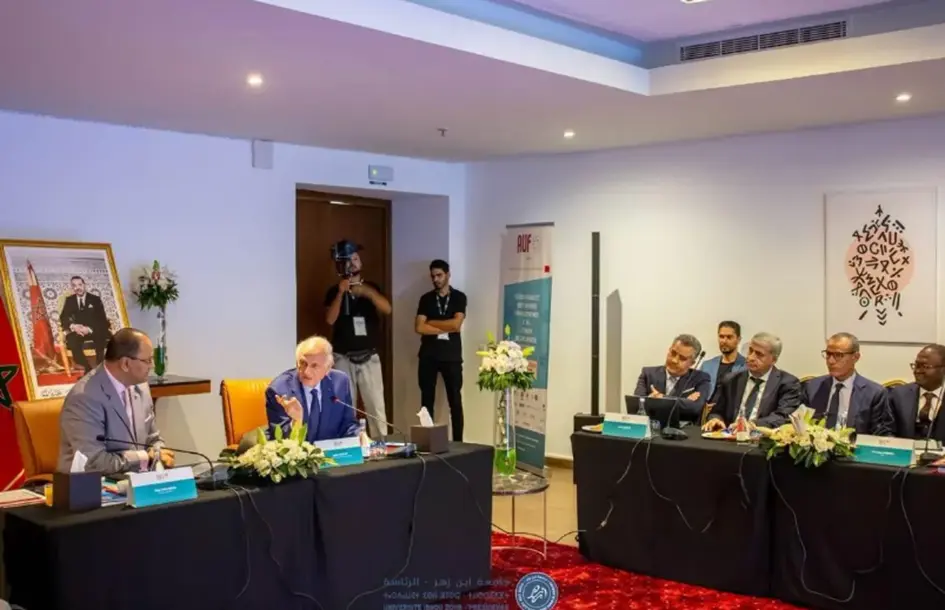
Ibn Zohr University is taking part in the 6th World Week of Scientific Francophonie (October 12–15, 2026), whose opening day saw the launch of UDEF 2026 in the presence of Royal Adviser André Azoulay.
Ibn Zohr University, headed by Professor Nabil Hmina, is continuing to strengthen its presence on the international academic stage through its participation in the sixth edition of the World Week of Scientific Francophonie, organized by the Agence universitaire de la Francophonie (AUF) from October 12 to 15, 2026. The event is part of an effort to consolidate university cooperation, promote scientific research and broaden partnership opportunities among higher education institutions across the Francophone world.
The first day, Monday, October 12, 2026, was marked by the presence of Royal Counsellor André Azoulay at a major scientific and academic event that saw the opening of the third edition of the Francophonie Summer University (UDEF 2026). Institutional and university officials, researchers, experts and international partners gathered to discuss the future of scientific cooperation and the challenges involved in producing and disseminating knowledge.
The presence of Royal Counsellor André Azoulay carried particular significance given his role in promoting dialogue among cultures and civilizations, as well as his contribution to embedding the values of diversity, openness and coexistence. These principles are closely aligned with the main objectives of scientific Francophonie, which is founded on knowledge-sharing, the promotion of multilingualism and cultural diversity, and the development of international academic cooperation.
Ibn Zohr University’s participation in this scientific gathering reflects the direction adopted by the university presidency, under the leadership of Professor Nabil Hmina, to expand its international relations network, diversify its academic and research partnerships and strengthen its engagement with global scientific initiatives. The aim is to enhance its position within the higher education, research and innovation system.
The scientific sessions on the first day featured discussions on several issues related to the future of university cooperation across the Francophone world, including support for scientific publishing in French, assistance for young researchers, and the development of mechanisms for exchanging expertise and knowledge among universities and research centers.
The speakers also highlighted the importance of multilingualism as a means of enriching scientific output and broadening its reach, while stressing the need to move academic cooperation toward more effective and sustainable partnerships. These should be based on the development of joint research projects, the promotion of innovation and the strengthening of universities’ ability to respond to the acceleration of scientific and technological change.
In the afternoon, a specialized scientific workshop was devoted to the theme: “Francophone Cultural and Creative Industries: What Training for the Future?” It presented an overview of university programs and professions linked to the cultural and creative industries across the Francophone world and explored their development prospects in light of current economic and professional transformations.
The workshop drew on the findings of a study conducted among universities, training institutions and institutional stakeholders. The study sought to assess the state of training programs related to these promising sectors and identify the challenges involved in aligning them with labor-market needs, particularly in developing digital and entrepreneurial skills and strengthening ties between universities and the economic and professional environment.
The discussions underscored the importance of investing in a qualified human capital base and integrating creative and technological skills into academic programs. This would enable universities to make a greater contribution to supporting the creative economy and open up new opportunities for young people in employment, entrepreneurship and innovation.
Within the same framework, the first day also hosted the Conference of University Presidents, devoted to prospects for academic and scientific cooperation in North Africa and to exploring new partnership opportunities among the region’s higher education institutions. The objective was to strengthen university integration, the exchange of expertise and the development of joint research initiatives.
The meeting provided a forum for exchanging views on ways to elevate cooperation among universities, mobilize available scientific and human resources, and strengthen academic institutions’ capacity to address common challenges, particularly in training, scientific research, innovation and skills development.
This participation is particularly important for Ibn Zohr University in view of the opportunities it offers to expand its presence within international academic networks, engage with diverse university experiences and explore new areas of scientific cooperation, in line with its ambitions to enhance its academic and scientific performance.
This momentum is also part of the transformations underway at Ibn Zohr University, including the expansion of its academic offerings, the diversification of its fields of specialization and the strengthening of its territorial presence. These efforts are being supported by the university presidency under the leadership of Professor Nabil Hmina, as part of a vision aimed at improving the quality of education, bringing higher education closer to students and linking the university more closely to regional and national development needs.
In this context, international engagement represents a natural extension of this momentum, serving as a means of developing scientific skills, encouraging the mobility of students, teachers and researchers, and expanding opportunities to participate in multilateral academic and research projects.
The challenge is not limited to being present at international scientific events. It also involves affirming the position of Moroccan universities as active partners in knowledge production and the exchange of expertise, while contributing to the creation of a more open and integrated university space, particularly with African academic institutions, in the face of the common challenges confronting higher education and scientific research systems.
Ibn Zohr University’s participation in this international event reflects the importance of relying on scientific and academic diplomacy as an essential mechanism for enhancing the international profile of university institutions, broadening the scope of cultural and intellectual cooperation, and showcasing Moroccan expertise in international research and innovation forums.
In this way, the World Week of Scientific Francophonie marks a new stage in Ibn Zohr University’s academic outreach and an opportunity to strengthen its presence within international university cooperation networks. It reflects the university’s ambition to evolve from a knowledge-producing institution into an open and influential academic actor, capable of contributing to the creation of lasting scientific partnerships and affirming the place of Moroccan universities on the African and international academic stage.